What Contains a Thought?
Reading time: 4 minutes
Context
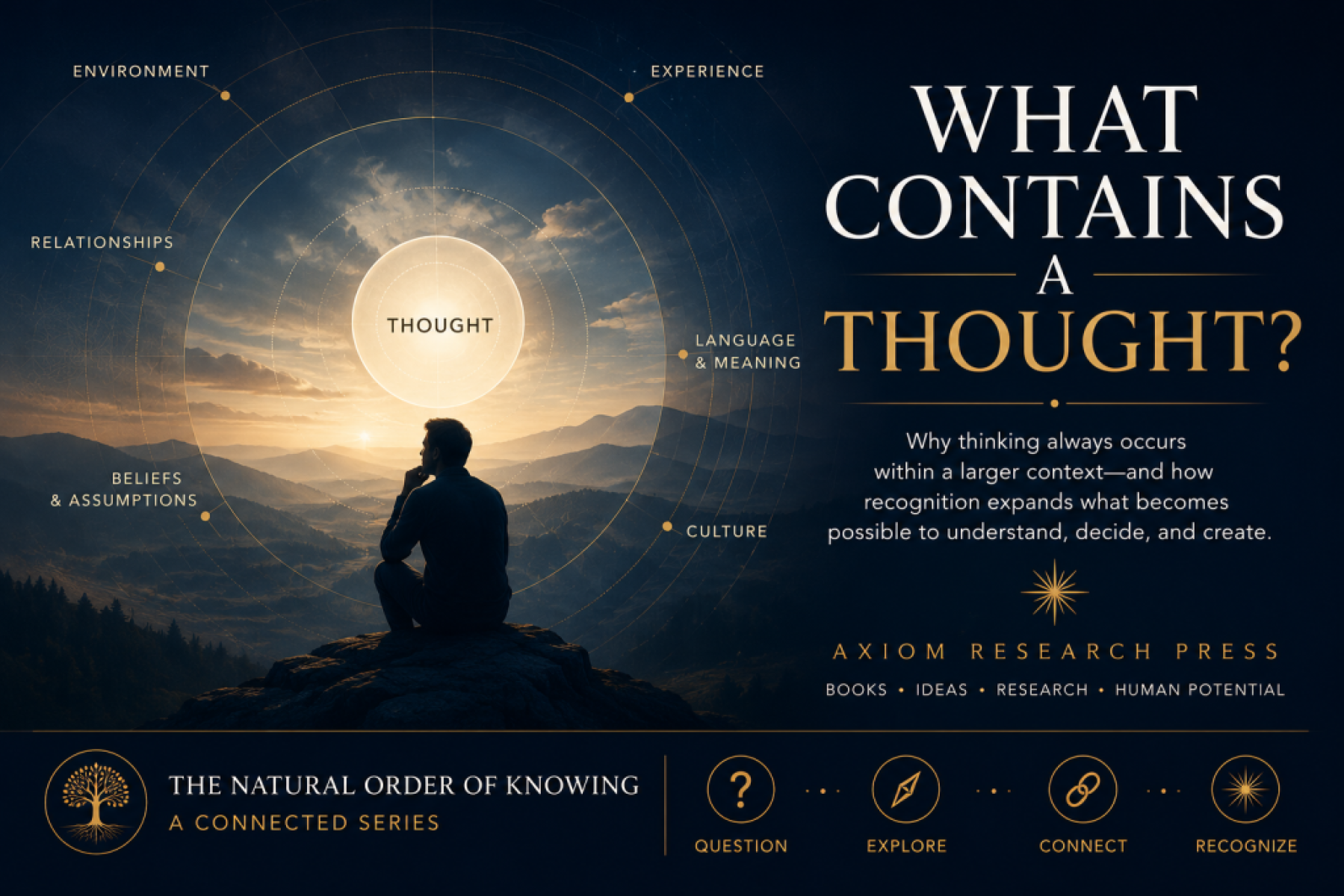
Professionals, researchers, educators, and decision-makers often place great confidence in rational thinking. We analyze information, weigh alternatives, develop strategies, and solve increasingly complex problems. Yet there is a question that is rarely asked:
What contains a thought?
The question may seem philosophical at first. In practice, it has profound implications. If every thought occurs within a larger context that it cannot fully represent, then the quality of our thinking depends not only on the thoughts themselves, but on the conditions from which those thoughts emerge.
We Usually Examine the Thought
When faced with a difficult decision, our attention naturally turns toward what we are thinking.
Is the reasoning sound?
Are the facts accurate?
Have we considered enough alternatives?
These are worthwhile questions.
But they all assume that the thought itself is the proper place to begin.
Perhaps it isn’t.
Perhaps the more fundamental question is not whether a thought is correct, but what made that particular thought possible in the first place.
Every Thought Arrives Within a Context
A thought does not appear in isolation.
It emerges within experience.
It depends upon what has been noticed, what has been ignored, what has been learned, what has been trusted, and what has become meaningful.
Remove those conditions, and the thought itself often disappears.
Change those conditions, and entirely new thoughts become possible.
This suggests something surprisingly simple:
A thought is not self-originating.
It participates in a larger process.
The Boundaries We Rarely Notice
Imagine standing in a room with only one window.
Everything you see through that window may be perfectly accurate.
Yet it is impossible to conclude that what lies beyond the window is all that exists.
Thought often functions the same way.
Reasoning can be internally consistent while remaining bounded by conditions it has never questioned.
The limitation is not necessarily faulty logic.
It is the invisible frame within which the logic is operating.
Recognition Changes What Can Be Thought
Most people have experienced the moment when a new insight suddenly reorganizes an entire problem.
Nothing external changed.
The facts remained the same.
Yet the solution that seemed impossible a moment earlier now appears obvious.
What happened?
The new thought was not manufactured out of nothing.
Rather, something became available that had not previously been recognized.
The change occurred before the explanation.
Recognition expanded what thinking could work with.
Why Better Thinking Is Not Always Enough
We often assume that better decisions require better thinking.
Sometimes they do.
But sometimes the limiting factor is not the quality of reasoning.
It is the range of relationships that reasoning has available to consider.
If an important relationship remains unseen, even flawless logic may arrive at an incomplete conclusion.
Improving the thought without expanding recognition is like polishing a compass that is pointing in the wrong direction.
Learning to Look Beyond the Thought
This does not diminish the importance of thinking.
Thought is one of humanity’s greatest tools.
But tools work within environments.
A hammer depends upon the carpenter.
A compass depends upon the traveler.
Thought depends upon the conditions from which it emerges.
When those conditions expand, thought naturally follows.
Questions Worth Carrying
Before asking whether a conclusion is correct, it may be worth asking:
- What relationships made this thought possible?
- What assumptions have quietly organized my reasoning?
- What might become thinkable if something previously unnoticed became visible?
These questions shift attention from defending thoughts to exploring the conditions that produce them.
Closing Thought
Perhaps the greatest limitation on thinking is not a lack of intelligence.
Perhaps it is forgetting that every thought occurs within a context it cannot completely contain.
When the context changes, the possibilities for thought change with it.
Understanding begins not by forcing better ideas, but by recognizing the larger relationships from which better ideas naturally emerge.
If thought cannot fully inspect the conditions that give rise to it, then the next question is unavoidable: How do those conditions become visible at all?
About the Research
This article is part of the ongoing work of the Axiom Research Institute, an initiative of Axiom Research Press exploring recognition, participation, decision-making, and the structures that shape human experience across disciplines.
This article is part of the foundational series: The Natural Order of Knowing.
Continue Exploring
These related explorations develop the idea further.


