How do we intentionally build systems that work?
Every system produces exactly what its structure makes possible. Organizations, technologies, markets, educational institutions, and communities are not defined by their intentions—they are defined by the relationships they establish, the information they allow to flow, and the decisions they consistently generate. When the same problems continue to appear, the system is often functioning exactly as it was designed.
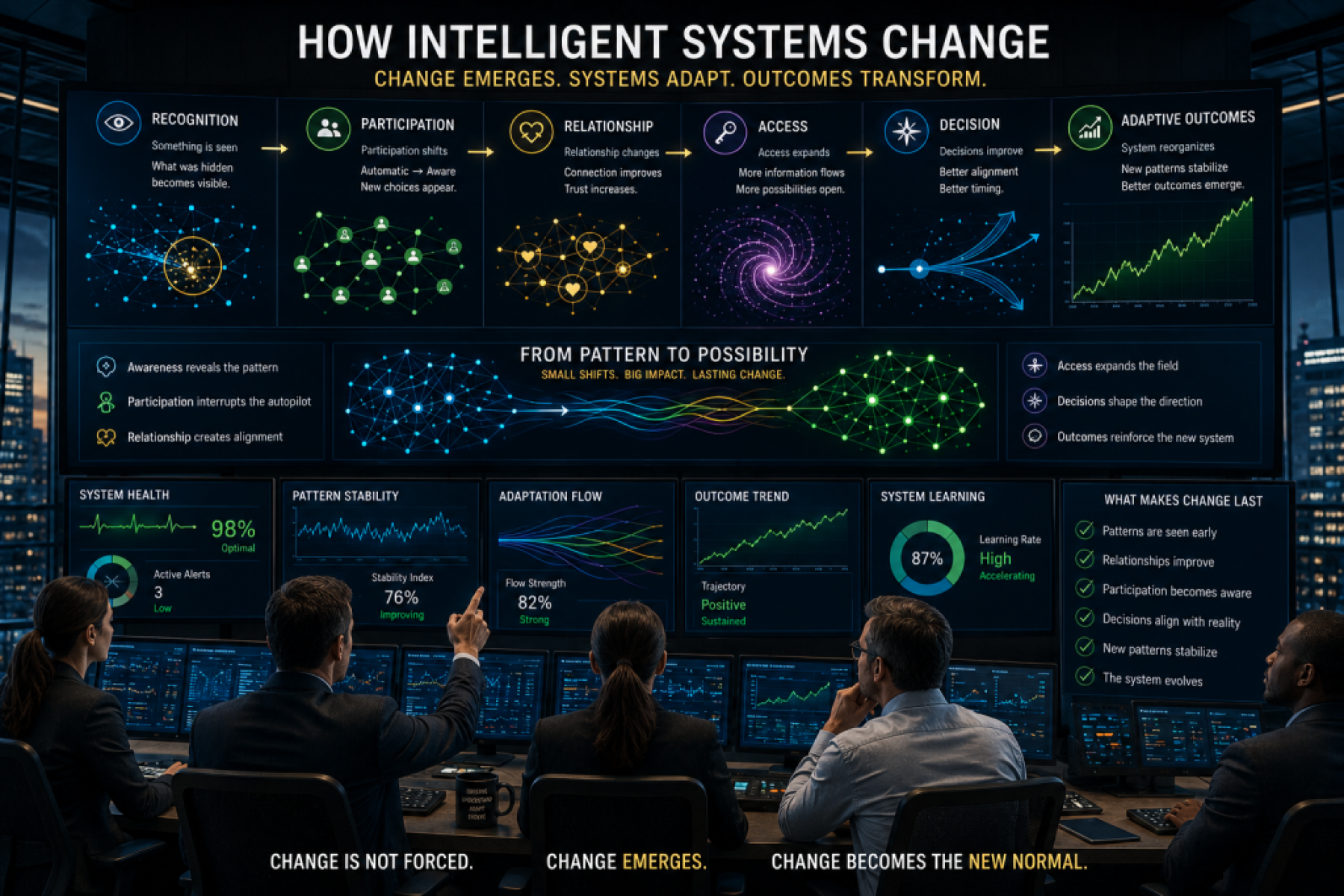
Systems Design begins with a different assumption: lasting improvement is rarely achieved by changing people—it is achieved by changing the structures within which people participate. Intelligent systems emerge when structure, participation, communication, recognition, access, and decision-making are intentionally designed to reinforce one another rather than compete.
Executives, investors, entrepreneurs, educators, researchers, engineers, and institutional leaders encounter this challenge continually. Organizations become trapped in recurring cycles. Innovation slows despite increasing investment. Communication expands while understanding diminishes. Decision-making becomes reactive rather than strategic. Although these challenges appear unrelated, they often arise from the same underlying question: What kind of system would naturally produce a different outcome?
The articles in this section examine how enduring principles can be intentionally incorporated into organizations, technologies, educational models, markets, artificial intelligence, governance, and human systems. Each article investigates one expression of a broader principle: intelligent systems are not assembled by adding isolated improvements—they emerge when every part participates in a coherent whole.
This perspective transforms the role of leadership itself. Rather than continually correcting recurring problems, leaders begin designing environments where many of those problems fail to emerge in the first place. Solving complex problems increasingly becomes an act of intelligent design—removing unnecessary friction, fragmentation, redundancy, and conflict until the system itself begins producing resilience, innovation, adaptability, and coherent action as natural consequences of its structure.
Systems design is not the conclusion of the framework. It is its practical expression. Every system ultimately reflects the principles upon which it was built, making the continual return to first principles not an academic exercise, but the foundation of sustainable improvement.