How Intelligent Systems Change
Reading time: 4 minutes
6 min read
Context
Executives, investors, educators, researchers, and professionals all face the same challenge: how to create meaningful change that lasts. Organizations launch transformation initiatives. Leaders introduce new strategies. Individuals attempt new habits. Yet many improvements prove temporary because they address outcomes rather than the relationships producing those outcomes. This article brings together the principles explored throughout this series and examines how lasting change emerges naturally within intelligent systems.
Much of what we call change…
is movement.
Not transformation.
Systems can be pushed.
Pressured.
Controlled.
Directed.
Yet when the pressure disappears…
many systems quietly return to familiar patterns.
Lasting change rarely begins that way.
It begins when the system itself begins relating differently.
What This Looks Like
A leader begins asking different questions.
An organization starts noticing earlier signals.
A team communicates differently.
A familiar response simply…
doesn’t occur.
The outward change may appear small.
The underlying change is profound.
Why Force Produces Temporary Results
Force can alter behavior.
It can increase compliance.
It can accelerate activity.
But force rarely changes the relationships generating the behavior.
When those relationships remain unchanged…
the original patterns often return.
Where Lasting Change Begins
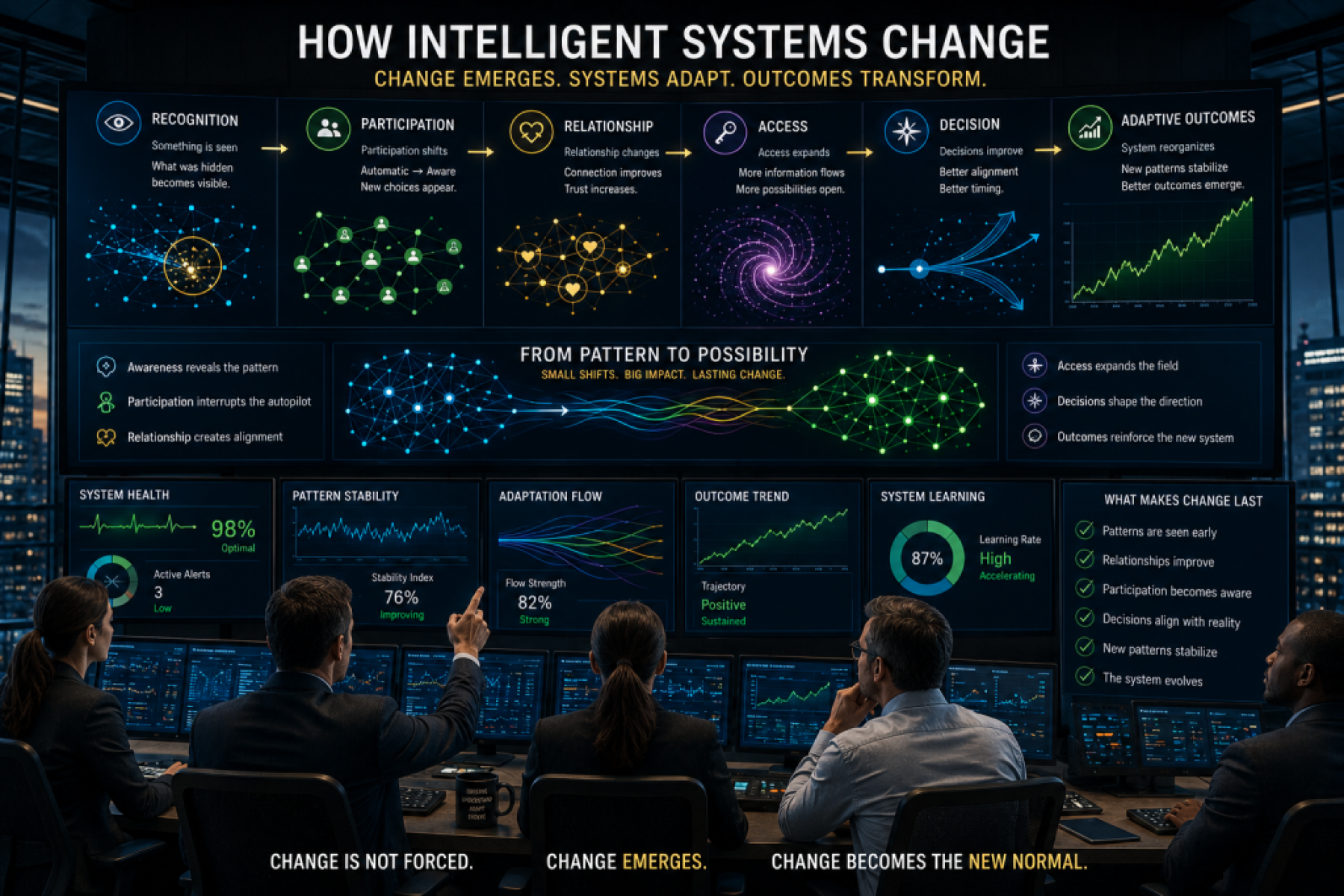
Meaningful change begins with recognition.
Recognition changes participation.
Participation changes relationship.
Relationship changes access.
Access changes understanding.
Understanding changes decisions.
Decisions gradually reshape the system itself.
This is not a sequence imposed from outside.
It is a sequence that emerges from within.
Why Awareness Alone Is Not Enough
Awareness creates possibility.
Recognition identifies structure.
But systems continue changing only when participation changes.
Observation without participation rarely transforms anything.
Participation is where understanding becomes lived behavior.
Why Relationship Changes Everything
Every intelligent system is organized through relationships.
Relationships determine how information moves.
How trust develops.
How adaptation occurs.
How learning stabilizes.
When relationships change…
the system reorganizes naturally.
Why Small Changes Become Large Ones
Complex systems accumulate.
A single interruption rarely changes everything.
Repeated intelligent participation does.
Small shifts compound.
New relationships stabilize.
Different outcomes gradually become normal.
Transformation often appears sudden.
Its development rarely is.
Why This Feels Different Than Effort
Forced change feels exhausting.
Adaptive change feels increasingly natural.
Not because action disappears.
Because unnecessary resistance does.
Healthy systems continue acting.
They simply stop working against themselves.
Why This Matters
Organizations.
Markets.
Communities.
Educational systems.
Technologies.
Individuals.
Each adapts most effectively when underlying relationships improve rather than when increasing amounts of force are applied.
Lasting transformation is rarely imposed.
It emerges.
How This Connects to Everything Else
- Recognition reveals structure.
- Participation changes relationships.
- Healthy relationships expand access.
- Expanded access improves decisions.
- Better decisions reshape systems.
This is how intelligent systems change.
First Principle
Lasting change emerges when the relationship organizes a system change. Force may alter behavior, but relationship reshapes the system itself.
Research Question
If intelligent systems consistently transform through changing relationship rather than increasing force, what conditions most reliably allow healthier relationship to emerge and stabilize across different domains?
Continue Exploring
These related explorations develop the idea further.
- The Architecture of Change
- How Some Systems Remain Stable Under Uncertainty
- The Partnership Most People Never Notice
Frequently Asked Questions
Why doesn’t force create lasting change?
Because force often changes behavior temporarily while leaving the relationship producing that behavior unchanged.
What creates lasting transformation?
Lasting transformation emerges when recognition, participation, relationship, and decision-making evolve together over time.
Does this apply only to organizations?
No. Similar principles appear across organizations, leadership, education, biology, technology, markets, and individual human experience.
Where should change begin?
Meaningful change usually begins where relationship, recognition, and participation first begin to shift—not where outcomes become visible.
Continue the Research
This article brings together the central observations explored throughout this series. Similar principles appear across leadership, organizational development, education, markets, engineering, biology, and human experience. Continue exploring how participation, relationship, recognition, access, and intelligent decision-making shape the behavior of complex systems.
Rob Mitchell is a researcher, author, and founder of Axiom Research Press. His work explores how structure, participation, relationship, recognition, and access influence learning, decision-making, organizational performance, and human potential across disciplines.
