How Can We Recognize Something We Have Never Seen?
Reading time: 4 minutes
Context
Every important discovery begins with something unfamiliar.
An executive recognizes an opportunity others have overlooked.
A scientist notices an unexpected result.
An entrepreneur sees possibilty.
A physician observes a pattern that doesn’t fit an existing diagnosis.
A child suddenly understands an idea they had never encountered before.
Yet all of these experiences raise the same question:
How can we recognize something we have never seen?
If recognition depended only upon memory, genuine discovery would be impossible.
Yet discovery happens every day.
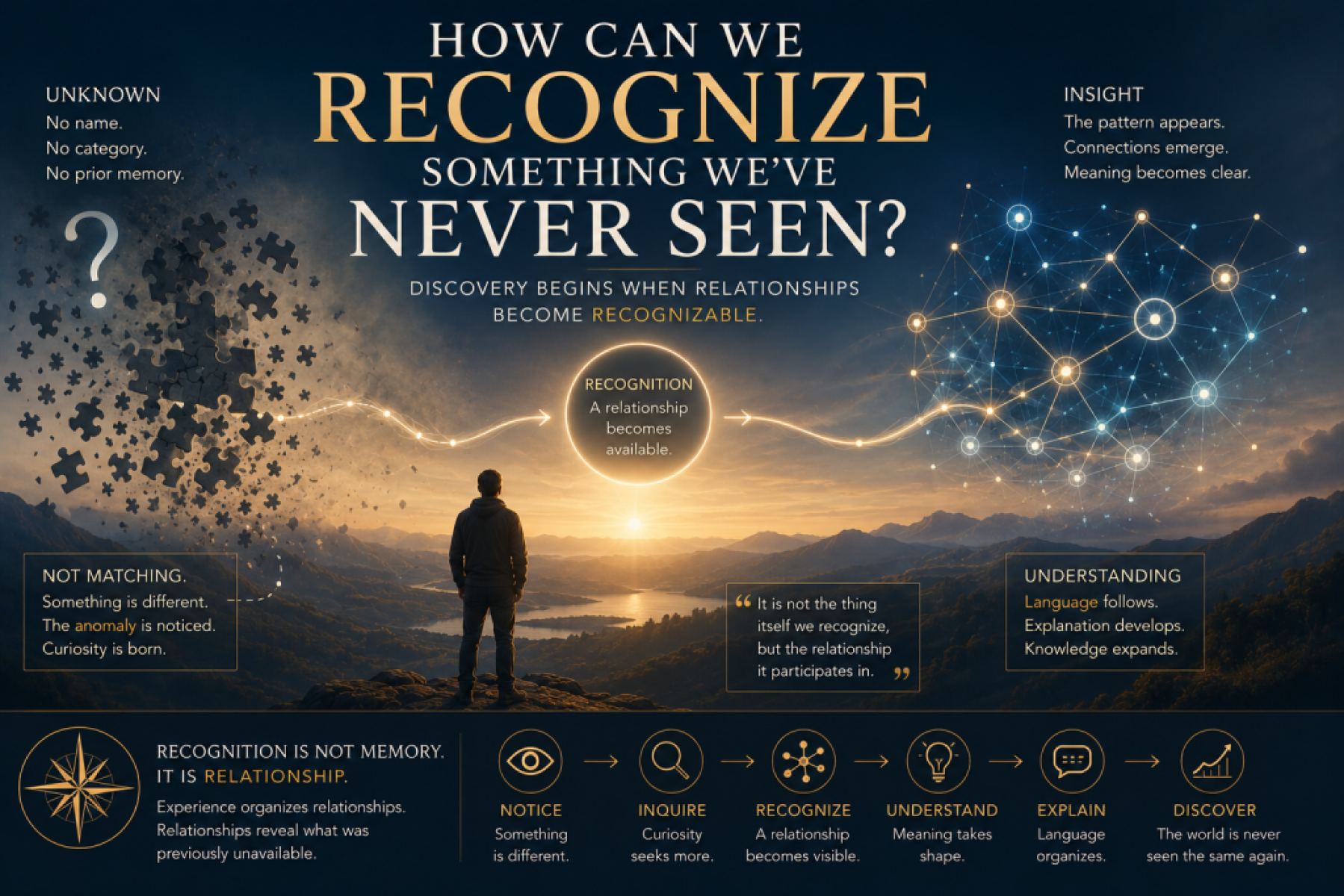
This article explores why recognition may depend less upon recalling the familiar than upon perceiving relationships that were previously unavailable.
The Paradox of Discovery
Imagine the first person to recognize electricity.
Or gravity.
Or bacteria.
No one had seen them before.
No existing category fully explained them.
No accepted language described them.
If recognition depended upon prior knowledge alone, none of these discoveries could have occurred.
Something else made recognition possible.
Recognition Is Not Matching
We often imagine recognition as a matching process.
We see something.
We compare it with memory.
If they match, recognition occurs.
That certainly explains many experiences.
Recognizing a friend’s face.
Finding your parked car.
Remembering a familiar melody.
But genuine discovery follows a different path.
Sometimes recognition occurs precisely because something refuses to match what we already know.
The anomaly itself becomes recognizable.
Relationship Before Identity
A child may not know the word gravity.
Yet they quickly recognize that objects fall.
An investor may not understand every market model.
Yet they recognize that something unusual is unfolding.
A physician may not yet know the diagnosis.
Yet they recognize that something doesn’t fit.
Recognition often begins with relationships rather than identities.
The pattern appears before the name.
Why Experts Notice More
Experience matters.
Not because experts memorize more information.
But because experience gradually organizes more relationships.
A chess master does not calculate every piece independently.
A musician does not hear isolated notes.
An experienced leader does not evaluate every conversation from the beginning.
Relationships become available almost immediately.
Recognition expands.
Thought follows.
Every Discovery Changes What Can Be Seen
One remarkable characteristic of recognition is that it changes future recognition.
Once you recognize a constellation, you never quite see the night sky the same way again.
Once a physician identifies a particular condition, similar cases become easier to recognize.
Once a trader sees a recurring market structure, charts begin organizing themselves differently.
Recognition reorganizes perception.
The world itself appears different, even though nothing external has changed.
Learning Is Expansion
Perhaps learning is not primarily the accumulation of information.
Perhaps it is the gradual expansion of recognizable relationships.
Information certainly matters.
Explanation matters.
Classification matters.
But they become valuable because recognition has already expanded what can be understood.
Closing Thought
The greatest discoveries rarely begin with certainty.
They begin with the recognition that something meaningful is present, even before we fully understand what it is.
Perhaps recognizing something we have never seen is not mysterious after all.
Perhaps relationship always extends beyond what language has already named.
If every new recognition expands what becomes recognizable next, what limits the boundaries of discovery?
Continue Exploring
These related explorations develop the idea further.
About the Research
This article is part of The Natural Order of Knowing, a foundational series from Axiom Research Press exploring recognition, language, thought, explanation, and the structures through which understanding naturally develops.


