How Interference Changes What We Are Able to See
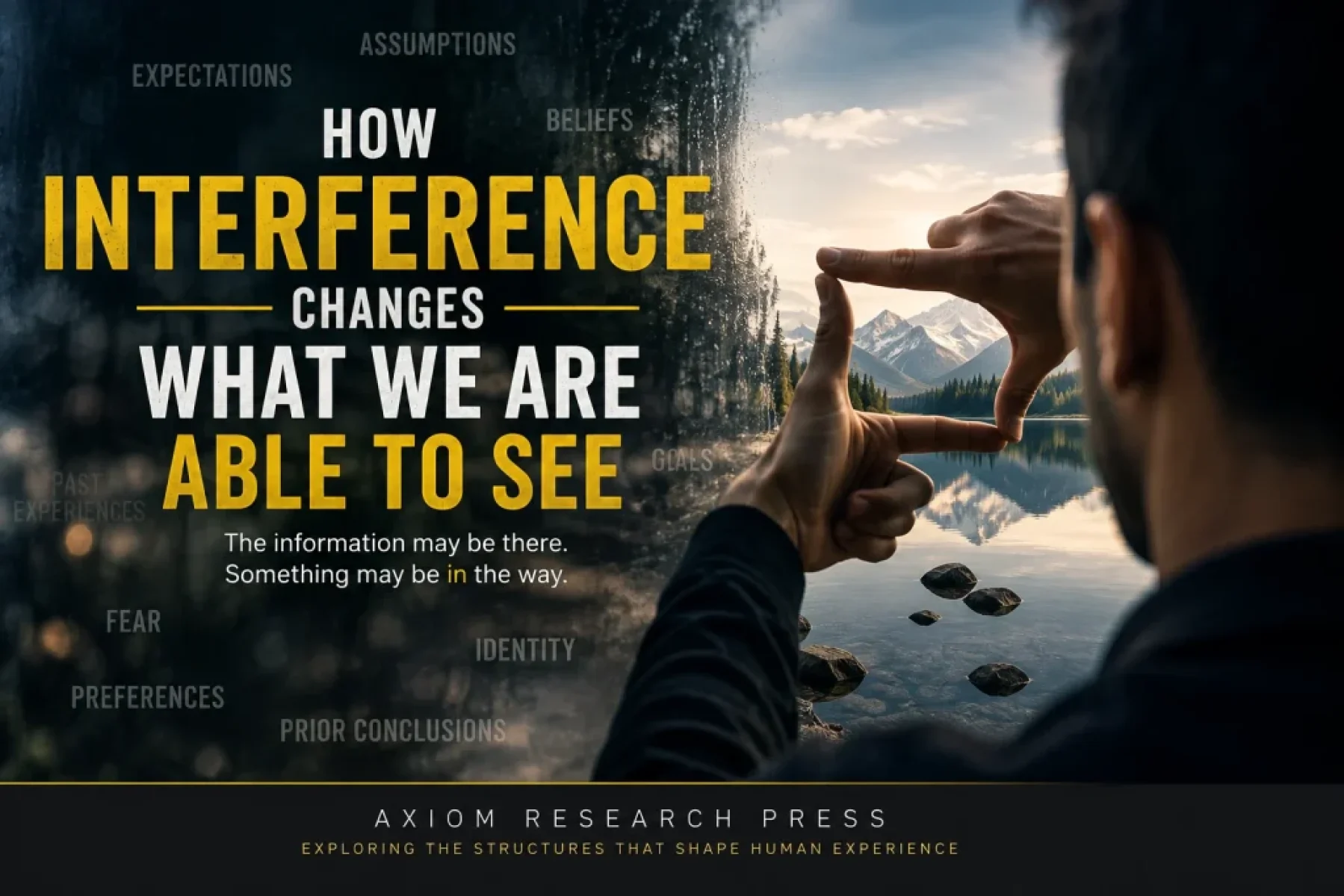
We often assume that seeing clearly is simply a matter of paying closer attention.
Look harder.
Think more carefully.
Gather more information.
But what if the problem is not that something is missing?
What if the information is already present…
and something is interfering with our access to it?
Seeing Is Not the Same as Looking
Two people can observe the same event and recognize very different things.
One notices opportunity.
Another notices danger.
One sees evidence that confirms an expectation.
Another sees evidence that challenges it.
The event may be the same.
The available information may be the same.
Yet the experience is not.
This suggests something important:
What becomes available to recognize may depend not only on what is present, but on the relationship we have with what is present.
Interference Can Be Almost Invisible
Interference does not need to be dramatic.
It may be an assumption.
An expectation.
A belief.
A goal.
A value.
A previous experience.
A role.
A preferred outcome.
Even something normally useful can become interference when it quietly narrows what we are able to consider.
The difficulty is that interference rarely announces itself.
It usually feels like reality.
When the Model Becomes the World
Suppose a problem is presented as having two possible answers.
Choice A.
Choice B.
The moment we accept that framing, something has already happened.
Every possibility outside those two choices has disappeared from consideration.
Not necessarily from reality.
Only from what we are currently able to see.
This is one way interference works.
It does not always distort the information in front of us.
Sometimes it removes possibilities before we ever begin examining them.
More Possibilities Can Create More Clarity
We often associate clarity with reduction.
Fewer choices.
Fewer variables.
Fewer possibilities.
Sometimes that helps.
But reduction can also become premature.
If reality contains four meaningful possibilities and our model permits only two, simplicity has not created clarity.
It has created interference.
Allowing another possibility does not necessarily make the problem more complicated.
It may make the situation more navigable.
That distinction matters.
Recognition Changes Before Explanation
There are moments when something becomes visible before we can explain why.
A pattern suddenly appears.
A relationship becomes obvious.
A contradiction can no longer be ignored.
Nothing new may have been added.
The structure was already there.
What changed was access.
This is one reason recognition can precede explanation.
We may see something before we know how to describe what we have seen.
Interference and Decision-Making
Decision-making is often treated as a process of selecting the best answer from the available choices.
But that description assumes the available choices are actually available to us.
What if they are not?
A decision can only include possibilities that have survived our assumptions, expectations, values, habits, and prior conclusions.
By the time conscious choice begins, much of the field may already have been removed.
This means better decisions may not begin with choosing more effectively.
They may begin earlier.
With seeing more.
Interference in Leadership and Organizations
The same structure appears inside organizations.
A leadership team may possess enormous amounts of information and still fail to recognize what is happening.
Why?
Because information alone does not guarantee access.
Organizational roles can become interference.
Incentives can become interference.
Shared assumptions can become interference.
Success itself can become interference when yesterday’s model determines what can be recognized today.
This is one of the recurring themes explored in the Executive Insights collection and the ongoing Executive Field Notes.
The question is rarely just:
What information are we missing?
Sometimes the more important question is:
What might we already have access to, but no longer be able to recognize?
Interference and Freedom
There is another consequence.
As interference increases, the number of possibilities we are able to recognize may decrease.
As interference decreases, additional possibilities may become available.
This changes more than perception.
It changes navigability.
And when navigability increases, our experience of freedom may change with it.
This relationship is explored from another direction in the Freedom Series, where brief observations examine how hidden assumptions in language, thought, identity, emotion, and experience can quietly constrain what becomes available to see.
Interference Does Not Need to Be Removed All at Once
There may be no final state in which every interference disappears.
Nor is that necessary.
A single assumption becoming visible can increase navigability.
A single additional possibility can change a decision.
A single recognition can alter a relationship.
Sometimes very little needs to change.
Something simply has to become visible that was invisible before.
A Different Question
When something seems confusing, difficult, or impossible, we often ask:
What am I missing?
That can be a useful question.
But there is another:
What might be interfering with what is already available to see?
The difference is subtle.
One assumes something must be added.
The other leaves open the possibility that something may simply need to become visible.
And sometimes that is enough.
Explore related work:


