Recognition Comes Before Thought
Reading time: 5 minutes
Context
Executives, scientists, educators, physicians, investors, artists, and parents all rely upon thinking to solve problems and make decisions. We naturally assume that thought is the beginning of understanding—that first we think, then we recognize.
Yet everyday experience often suggests something different.
The solution suddenly appears.
The pattern that was invisible yesterday becomes obvious today.
The familiar face is recognized before a single word is spoken.
This article explores a simple possibility:
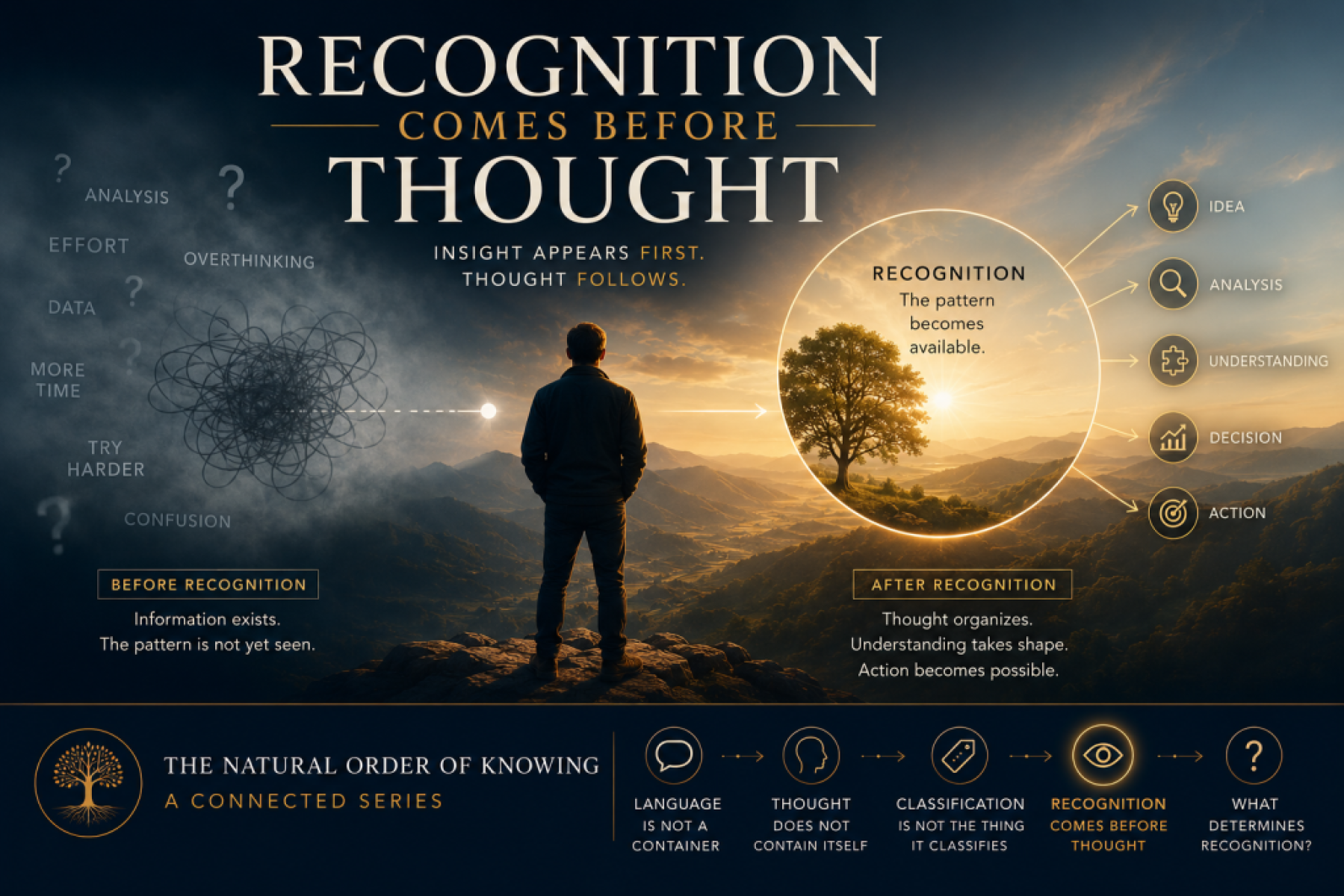
Recognition may not follow thought. Thought may follow recognition.
The Moment You Suddenly See It
Almost everyone has experienced it.
A difficult problem remains unsolved for days.
Then, seemingly without effort, the answer appears.
Nothing external changed.
The information was already available.
The facts were the same.
What changed was not the data.
What changed was what became recognizable.
Only afterward did thought begin organizing the insight into explanation.
Thinking Organizes
Thought is extraordinarily powerful.
It compares.
It analyzes.
It sequences.
It evaluates.
It explains.
But notice something interesting.
Thinking can only organize what has already become available to it.
It cannot analyze a relationship that has not yet been recognized.
The limitation is not intelligence.
The limitation is access.
Recognition Changes the Landscape
Imagine walking through a forest.
Someone points out a particular species of tree.
For the rest of the day, you suddenly see dozens of them.
Did the trees appear?
Of course not.
Recognition changed.
Once recognition expanded, thought immediately began organizing the new information.
You compared.
You remembered.
You classified.
You explained.
Recognition quietly arrived first.
Discovery Often Begins This Way
Scientific discovery rarely begins with a conclusion.
It often begins with someone noticing something that everyone else overlooked.
An unexpected observation.
An anomaly.
A recurring pattern.
Only later does explanation begin.
History remembers the theory.
It often forgets the recognition that made the theory possible.
Recognition Cannot Be Forced
This may explain why more effort does not always produce better understanding.
Many of our greatest insights occur while walking, driving, showering, or simply allowing attention to relax.
Thinking did not stop.
But deliberate effort was no longer leading the process.
Recognition emerged.
Thought followed.
Why This Matters
If recognition comes before thought, then learning changes.
Leadership changes.
Innovation changes.
Decision-making changes.
Rather than asking only:
“How can I think better?”
another question becomes equally important:
“What conditions make better recognition possible?”
That question shifts attention from improving thought to improving access.
Recognition Is Not Irrational
Some people hear the word recognition and assume intuition, instinct, or emotion.
Recognition is none of those by definition.
Recognition is simply the moment when a previously unavailable relationship becomes available.
Sometimes that relationship is emotional.
Sometimes mathematical.
Sometimes scientific.
Sometimes deeply personal.
The domain changes.
The structure does not.
Closing Thought
Thought remains one of humanity’s greatest capacities.
But perhaps its greatest strength is not creating understanding.
Perhaps its greatest strength is organizing what recognition has already made available.
When recognition expands, thought naturally follows.
If recognition makes new thoughts possible, what determines what becomes recognizable in the first place?
About the Research
This article is part of The Natural Order of Knowing, a foundational research series from Axiom Research Press exploring recognition, thought, language, explanation, and the structures through which understanding naturally develops.
Continue Exploring
These related explorations develop the idea further.


