When Force Creates Resistance
Reading time: 4 minutes
Context
Executives, investors, educators, researchers, and professionals frequently encounter situations where increasing effort produces diminishing results. Organizations push harder yet become less adaptable. Negotiations become more difficult as pressure increases. Teams lose creativity when control replaces participation. Although these situations appear unrelated, they often illustrate the same underlying question: Why does increasing force frequently generate increasing resistance? This article examines one expression of that broader pattern and why understanding it changes how complex systems are approached.
At some point…
most people notice it.
The harder they push…
the more difficult things become.
More pressure.
More control.
More effort.
For a while…
it appears to work.
Until it doesn’t.
Resistance increases.
Tension builds.
Progress slows.
Then something unexpected happens.
The pressure is reduced.
And the system begins behaving differently.
What This Looks Like
You stop forcing an outcome…
and movement begins.
You stop trying to control every variable…
and clarity appears.
You stop demanding an immediate answer…
and the appropriate response becomes easier to recognize.
At first…
it can feel as though you are doing less.
Yet something begins working better.
Why Force Creates Resistance
Force changes the relationship within a system.
Pressure increases.
Resources shift toward maintaining stability.
Adaptability decreases.
Resistance is rarely evidence that something is broken.
More often…
it is how healthy systems protect themselves against excessive pressure.
What Happens When Pressure Is Reduced
As unnecessary pressure diminishes…
tension begins to decline.
Attention becomes available.
Recognition improves.
Automatic responses weaken.
And something important begins to emerge.
Space.
Why Space Matters
Space creates alternatives.
Without it…
systems frequently repeat existing patterns.
With it…
new possibilities become visible.
Responses become less automatic.
Participation becomes more intelligent.
Why This Isn’t Inaction
Reducing force is not the same as avoiding action.
Decisions still occur.
Work continues.
Progress remains possible.
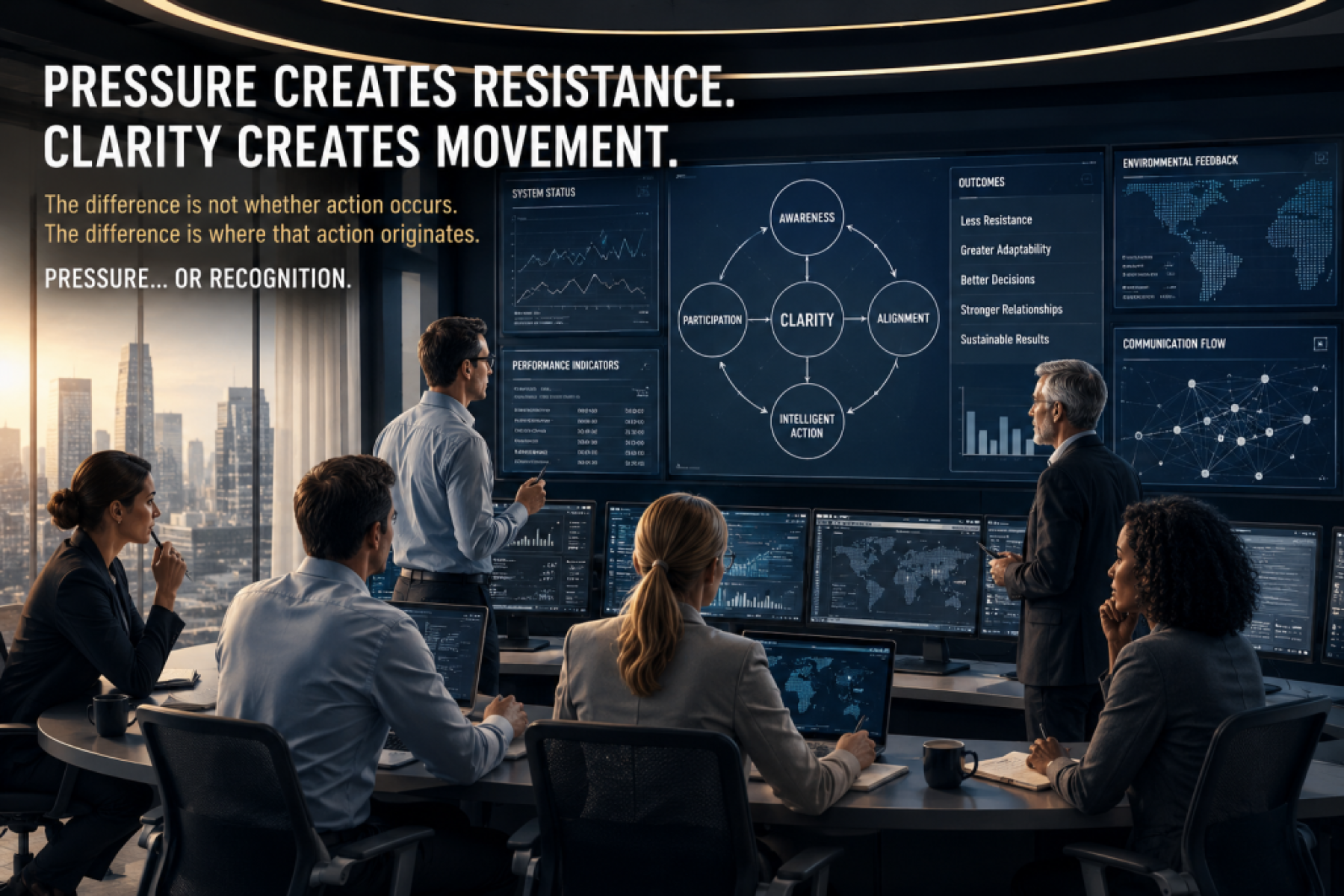
The difference is not whether action occurs.
The difference is where that action originates.
Pressure…
or recognition.
What Changes
Decisions become simpler.
Communication improves.
Relationships stabilize.
Adaptation becomes easier.
The system is no longer spending unnecessary resources working against itself.
Why This Often Feels Like Flow
People describe this experience in many different ways.
Flow.
Ease.
Momentum.
Being “in the zone.”
Although the language differs…
the underlying observation is remarkably similar.
Less unnecessary interference.
More intelligent participation.
Why This Matters
Across organizations, markets, education, biology, leadership, and human experience…
systems frequently become more effective not because additional force has been applied…
but because unnecessary resistance has been removed.
Sometimes improvement begins…
not by pushing harder…
but by allowing healthier relationships within the system to emerge.
How This Connects to Everything Else
- This is why participation often outperforms control.
- This is why recognition improves decision-making.
- This is why reducing interference expands access.
- This is why healthy relationships increase intelligent action.
Not because less happens.
Because more becomes possible.
First Principle
Healthy systems often improve not by increasing force, but by reducing unnecessary interference.
Research Question
If unnecessary force often creates unnecessary resistance, what system conditions consistently allow intelligent action to emerge with less effort and greater adaptability?
Continue Exploring
These related explorations develop the idea further.
- The Partnership Most People Never Notice
- The Difference Between Action and Reaction
- The Architecture of Change
Frequently Asked Questions
Why does increasing pressure sometimes reduce performance?
Many complex systems respond to excessive pressure by protecting existing structures rather than adapting to new conditions. This often appears as resistance.
Does reducing force mean lowering standards?
No. Reducing unnecessary force changes how action occurs, not whether meaningful action occurs.
Can organizations experience the same pattern?
Yes. Organizations, teams, markets, technologies, and individuals frequently become more adaptable as unnecessary friction and internal resistance are reduced.
What replaces force?
Recognition. As understanding improves, action increasingly emerges from clarity rather than pressure.
Continue the Research
This article examines one observable expression of a broader first principle. Similar patterns appear across organizational leadership, negotiation, markets, education, technology, biology, and human experience. Continue exploring how participation, relationship, recognition, access, and intelligent decision-making shape the behavior of complex systems.
Rob Mitchell is a researcher, author, and founder of Axiom Research Press. His work explores how structure, participation, relationship, recognition, and access influence learning, decision-making, organizational performance, and human potential across disciplines.


