How Some Systems Remain Stable Under Uncertainty
Reading time: 4 minutes
Context
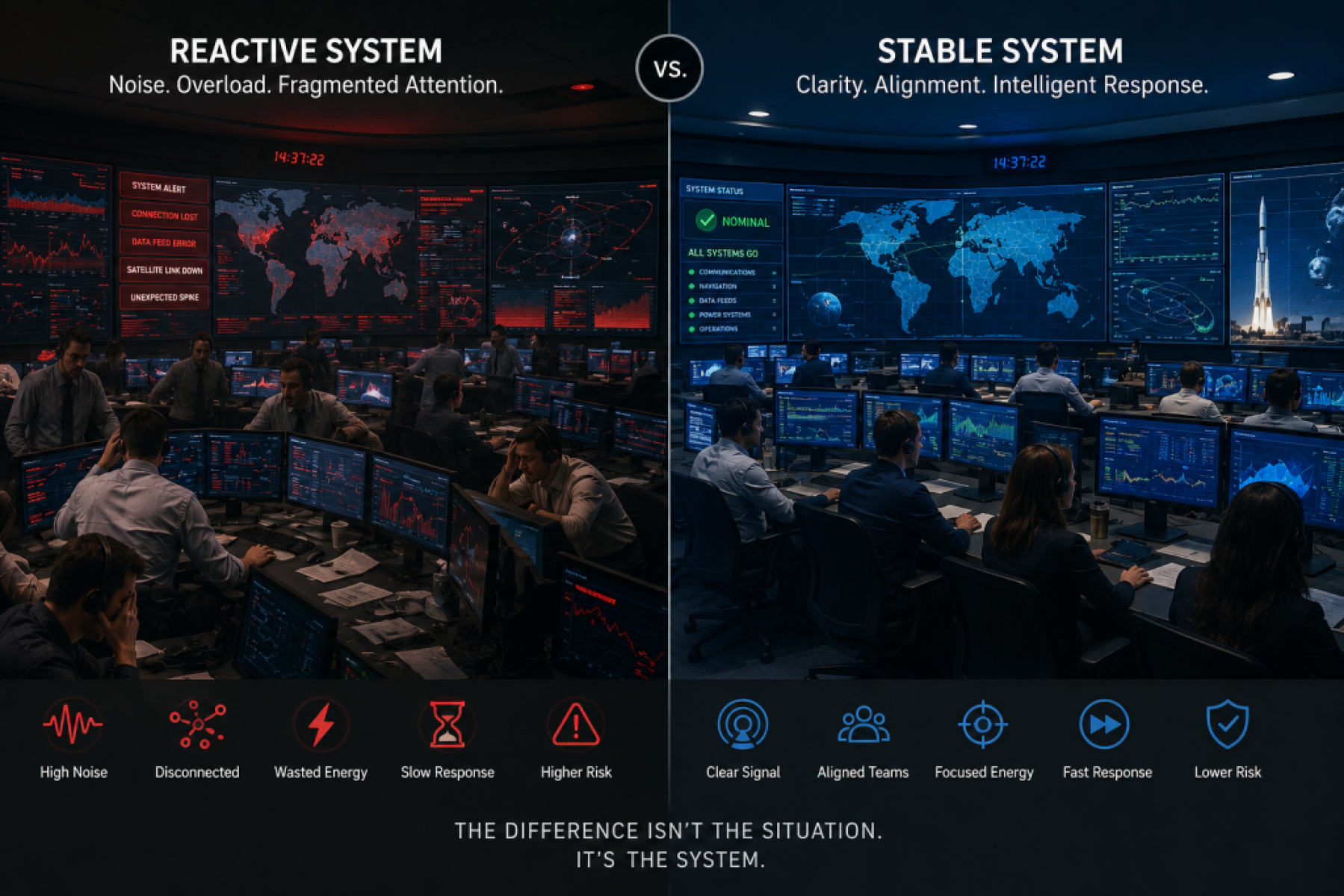
Executives, investors, educators, researchers, and professionals regularly encounter systems operating under uncertainty. Sometimes those systems are organizations, markets, teams, technologies—or individuals. Although the context changes, the underlying question often remains the same: Why do some systems remain remarkably stable while others become increasingly reactive? This article examines one expression of that broader pattern and why recognizing its underlying structure changes how resilience, leadership, and intelligent performance are understood.
You’ve probably seen it.
Consider a person operating within a situation that would normally create stress…
Pressure.
Uncertainty.
Intensity.
And yet…
They remain calm.
Not distant.
Not disconnected.
Present.
Clear.
Steady.
What This Feels Like to Observe
They don’t overreact.
They don’t rush.
They don’t get pulled into chaos.
They respond.
Simply.
Directly.
And it can feel almost unusual.
Because most people are accustomed to seeing something very different.
What Most People Assume
That they’ve learned exceptional self-control.
That they’re unusually disciplined.
That they’re suppressing emotion.
Or simply managing stress better than everyone else.
But that’s rarely what is actually happening.
What’s Actually Different
The system is experiencing less internal conflict.
Less resistance.
Less unnecessary interference.
It is no longer working against itself.
Because of that…
Information is no longer being significantly distorted by internal interference.
Why This Changes Everything
When internal conflict is low…
Resources are no longer consumed by unnecessary internal conflict.
Attention remains available.
Perception becomes clearer.
Response becomes increasingly natural.
This is often what creates the experience we describe as calm.
Why This Isn’t About Circumstances
Most people associate calm with external conditions.
If circumstances improve…
they feel better.
If uncertainty increases…
they become unsettled.
But what you’re observing here is something different.
The stability is not coming from the situation.
It is not dependent upon it.
Many people experience moments of calm…
through meditation, mindfulness, nature, or other practices.
Those experiences are real.
But they do not always persist.
Because a calm state…
is not the same as a clear system.
When the underlying structures remain unchanged…
the experience often disappears as circumstances change.
But when the system itself becomes increasingly aligned…
calm is no longer something temporarily experienced.
It becomes a stable characteristic of the system itself.
A Simple Way to See It
Think about nature.
It does not force outcomes.
It does not attempt to control every variable.
It functions.
Not perfectly.
But remarkably reliably—provided unnecessary interference is absent.
The same principle often applies within human systems.
What It Actually Is
It is what remains when a system is no longer working against itself.
No constant internal argument.
No continual second-guessing.
No unnecessary effort to force control.
Simply presence.
And from that…
something else begins to emerge.
What Begins to Emerge
There is a quiet sense that things are okay.
Not because everything is perfect…
But because the system is no longer divided against itself.
This may be experienced as peace.
Or stability.
Or clarity.
Or simply…
being at ease.
Why This Can Look Like Confidence or Charisma
To others, it often appears as:
- Confidence
- Presence
- Charisma
- Stability
These are surface descriptions.
Underneath…
the relationships within the system have become increasingly coherent.
Why This Changes Relationships and Outcomes
When you are no longer reacting from internal conflict…
you naturally respond differently.
And when your participation changes…
other people respond differently.
Situations begin unfolding differently.
Not because you are controlling them—
but because you are no longer distorting them through unnecessary interference.
How This Connects to Everything Else
- This is why alignment matters.
- This is why reducing interference changes outcomes.
- This is why clarity feels different from certainty.
- This is why recognition often precedes intelligent action.
Not by creating stability.
But by allowing it to emerge.
Continue Exploring
These related explorations develop the idea further.
- The Architecture of Change
- The Partnership Most People Never Notice
- When Systems Continue Producing the Same Results
Frequently Asked Questions
Why do some people remain calm under pressure?
Because the system is experiencing less internal conflict and therefore less interference. Attention remains available, perception becomes clearer, and intelligent response replaces automatic reaction.
Is this emotional control?
No. Suppression requires continual effort. This article describes a reduction in unnecessary internal conflict, allowing more coherent participation with the situation itself.
Can organizations demonstrate the same principle?
Yes. Organizations, teams, markets, and individuals often exhibit remarkably similar patterns. Systems experiencing less internal fragmentation typically make clearer decisions, communicate more effectively, and adapt more naturally under uncertainty.
Can this pattern be developed?
The pattern often emerges as unnecessary interference is reduced. Rather than adding new techniques, the process increasingly involves recognizing and removing what prevents the system from functioning coherently.
Related Research
This article examines one observable expression of a broader principle. Similar patterns appear across organizations, markets, education, leadership, technology, and human experience. Continue exploring how participation, relationship, recognition, access, and intelligent decision-making shape the behavior of complex systems.
Rob Mitchell is a researcher, author, and founder of Axiom Research Press. His work explores how structure, participation, relationship, recognition, and access influence learning, decision-making, organizational performance, and human potential across disciplines.


